
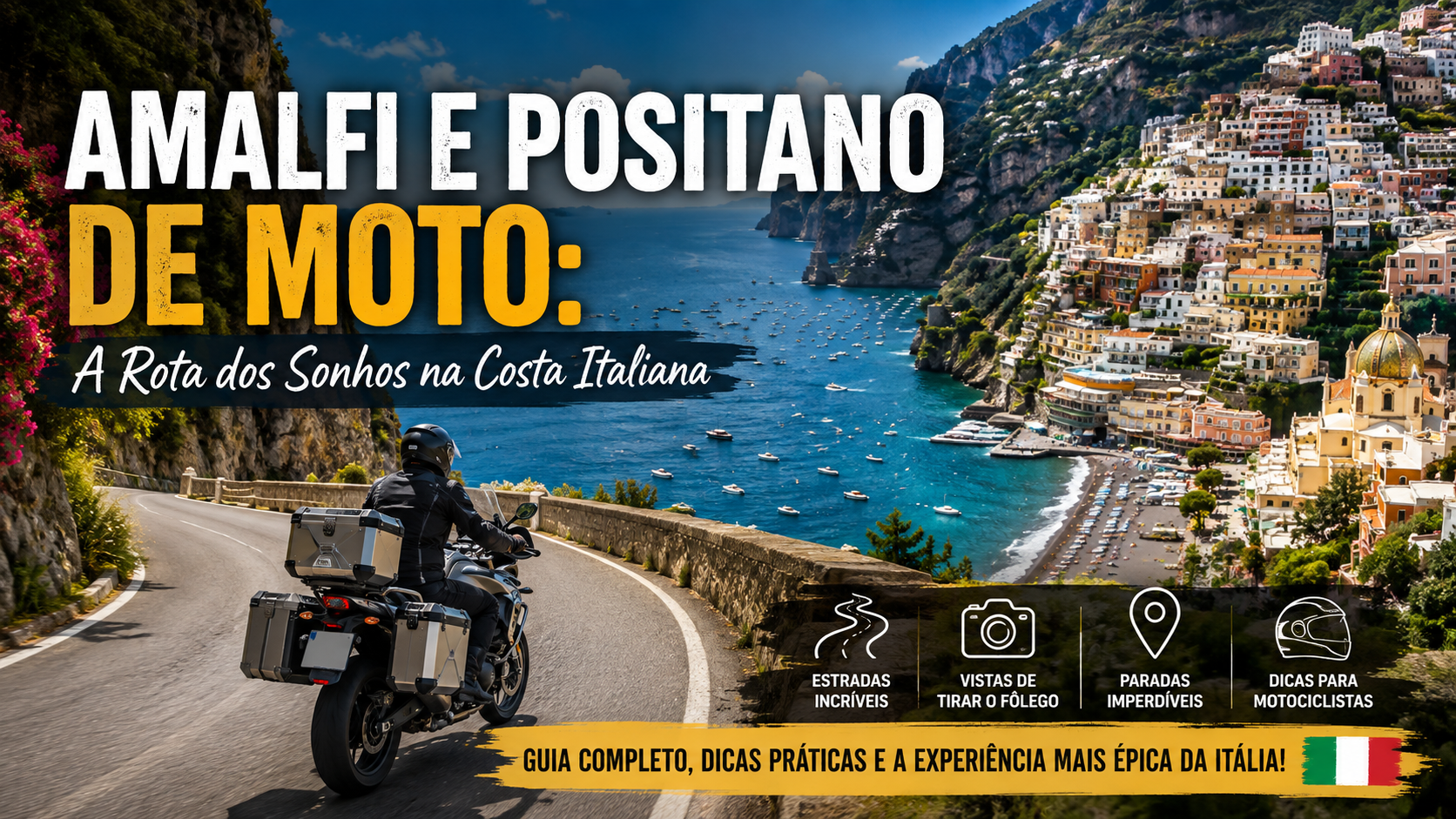
Riding the Amalfi Coast by Motorcycle: Italy's Most Spectacular Road
There was a thin mist that morning when I turned onto the SS163 at Vietri sul Mare. Within minutes, the Mediterranean opened to my left — deep green, endless, sunlight cutting across the surface in long golden strips. To the right, solid rock. Ahead, a succession of curves disappearing toward the horizon.
I slowed down. Not out of caution — but because rushing through something like this would be a crime.
The Amalfi Coast is one of the most photographed places on earth. You've seen the images: colourful buildings stacked up sheer cliffs, fishing boats in impossible blue water, lemon groves terraced above the sea. But there's an enormous difference between looking at those images and actually being there — helmet on, sea wind in your face, engine humming beneath you.
On a motorcycle, the Amalfi Coast isn't a backdrop. It's a full sensory experience.
Why Ride It Rather Than Drive It
The SS163 — Statale Amalfitana runs 50 km from Vietri sul Mare to Positano, hugging cliffs above the Tyrrhenian Sea. It was carved from the rock in the 19th century by order of Bourbon king Ferdinand II, and it remains one of the most dramatic pieces of road engineering in Europe.
By car it's beautiful. By tour bus it's uncomfortable — large vehicles barely fit through the narrower sections, and drivers spend the journey stress-watching their wing mirrors. By motorcycle, you have something the others don't: freedom of movement. You can stop anywhere, hold a viewpoint as long as you like, navigate around traffic, find parking where cars can't. It is, by a wide margin, the best way to experience this road.
The Route: Stop by Stop
Most riders base themselves in Naples or Salerno. Starting from Salerno is recommended — you enter the coast east to west, keeping the sea mostly to your left, and the most dramatic views build gradually toward the end.
Vietri sul Mare — The Gateway
The eastern entrance to the coast, known for its hand-painted ceramic tiles that cover building facades, benches and fountains throughout the town. A quick stop before the SS163 begins in earnest.
Cetara and Maiori
Two fishing villages that most tourists roll straight through. Cetara is famous for colatura di alici, a fermented anchovy sauce with a deep, punchy flavour used throughout southern Italian cooking. Worth a taste. Maiori has the longest beach on the coast — a good stop if you want to put your feet in the water.
Minori and Atrani
Minori is quiet and elegant. Atrani is the smallest municipality on the Italian mainland and one of the most photogenic: a tiny piazza just metres from the sea, ringed by buildings with coloured balconies. Worth leaving the bike and exploring on foot.
Amalfi — The Capital
The city that names the entire coast. In the 9th century, Amalfi was one of the most powerful maritime republics in the Mediterranean, rivalling Venice and Genoa in sea trade. The Duomo di Sant'Andrea — with its 57-step staircase and Arab-Norman facade — is one of the most striking monuments in southern Italy.
Amalfi's streets are narrow and perpetually busy. Leave the motorcycle at one of the signposted car parks outside the centre and explore on foot. The limoncello here is homemade, cold, and completely serious.
Praiano
Less celebrated than its neighbours, Praiano may have the best views on the entire coast: the village cascades down the hillside to the water's edge, and from certain points on the road you can see both Positano and the Gulf of Salerno simultaneously.
Positano — The Finish Line
The final destination, and the most photographed. Positano doesn't disappoint — even if you've already seen a thousand photographs. Domed rooftops in pink and terracotta stacked up the cliff face, the campanile of Santa Maria Assunta rising through the buildings, the small dark-pebble beach at the base of the town.
Arrive early — Positano gets overwhelmed with visitors in summer, and access is restricted from a certain hour onward. Walk down to the beach, have an espresso on the waterfront, look at the sea. You'll understand why people come from all over the world to stand in exactly this spot.
Essential Tips for Riding the SS163
Timing
The coast clogs badly between 10am and 5pm, especially in summer. Leave before 8am — you'll have the road almost to yourself, the morning light is exceptional, and you arrive in Positano ahead of the crowds. Or ride it late afternoon, once the tour buses have headed back.
Traffic
The SS163 is single-lane in many sections. Tour buses, delivery vans and tourist cars share the space — sometimes with literal centimetres to spare. Keep your speed low, don't overtake on blind corners, and be patient. This is not a road for urgency.
Viewpoints
There are dozens along the coast, many informal — a widened shoulder, a curve with a gap in the barrier. When you find a good one, stop. The road tells you when it's worth pulling over.
Fuel
Petrol stations on the SS163 are rare. Fill up properly before entering the coast (Salerno has plenty of stations) and don't count on finding one mid-route.
Return Route Options
Most riders do the coast in one direction. If you go back the same way, you see everything from a different angle — and it's worth it. Alternatively, head inland via Ravello or Scala: narrower roads still, but the views from the high ground looking back down over the coast are extraordinary.
Best Time to Go
May and September are the sweet spot — reliable weather, sea still warm, significantly less traffic than peak summer. June, July and August are stunning but crowded, especially on weekends. October is cooler but offers cinematic autumn light and almost empty roads.
Avoid Italian public holidays and August weekends: the SS163 can become a car park.
Getting There from Milan
If you're flying into Milan Malpensa Airport and want to include the Amalfi Coast in your Italian trip, Moretto Moto Rental can help you plan the full route. Milan to the Amalfi Coast is approximately 750 km — a journey that naturally passes through Bologna, Florence and Rome. You ride the north, descend south, hit the coast, and return.
We offer touring motorcycles maintained for long-distance travel, ready to handle everything the Amalfi Coast throws at them. Our team speaks Portuguese, Italian and English.
Contact us: rent@morettomoto.com | +39 3451596259 | www.morettomoto.com
Is It Worth It?
Yes. Without any hesitation.
The Amalfi Coast isn't just a beautiful road — it's the kind of place that changes how you think about travel. When you're out there on the SS163, with the Mediterranean below you and the cliff face beside you, you understand that some things in the world are genuinely extraordinary. And that the best way to experience them is on a motorcycle, at the speed of someone who wants to absorb everything.
People who go by bus see the Amalfi Coast. People who go by motorcycle feel it.
Come to Italy by motorcycle. This is the road you've been waiting for.
Important notice: this content is for information only. Distances, times, fares, opening hours and traffic rules (such as ZTL zones and speed limits) can change often and vary from town to town. Before you travel, always check official sources and confirm your trip details with Moretto Moto Rental.