Milan, Stelvio, Resia and Maloja: A Motorcycle Route Through the Italian Alps in One Day
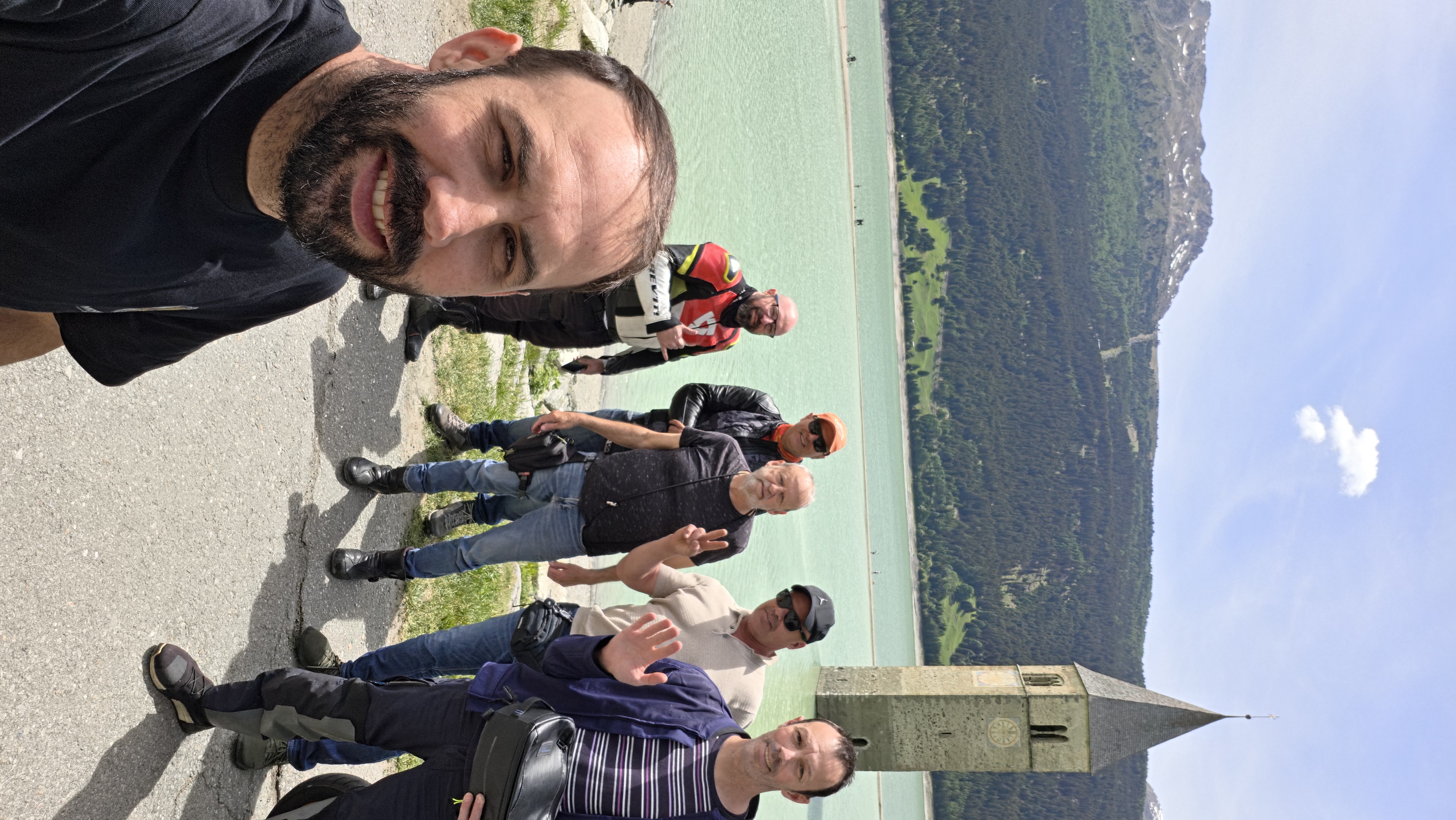
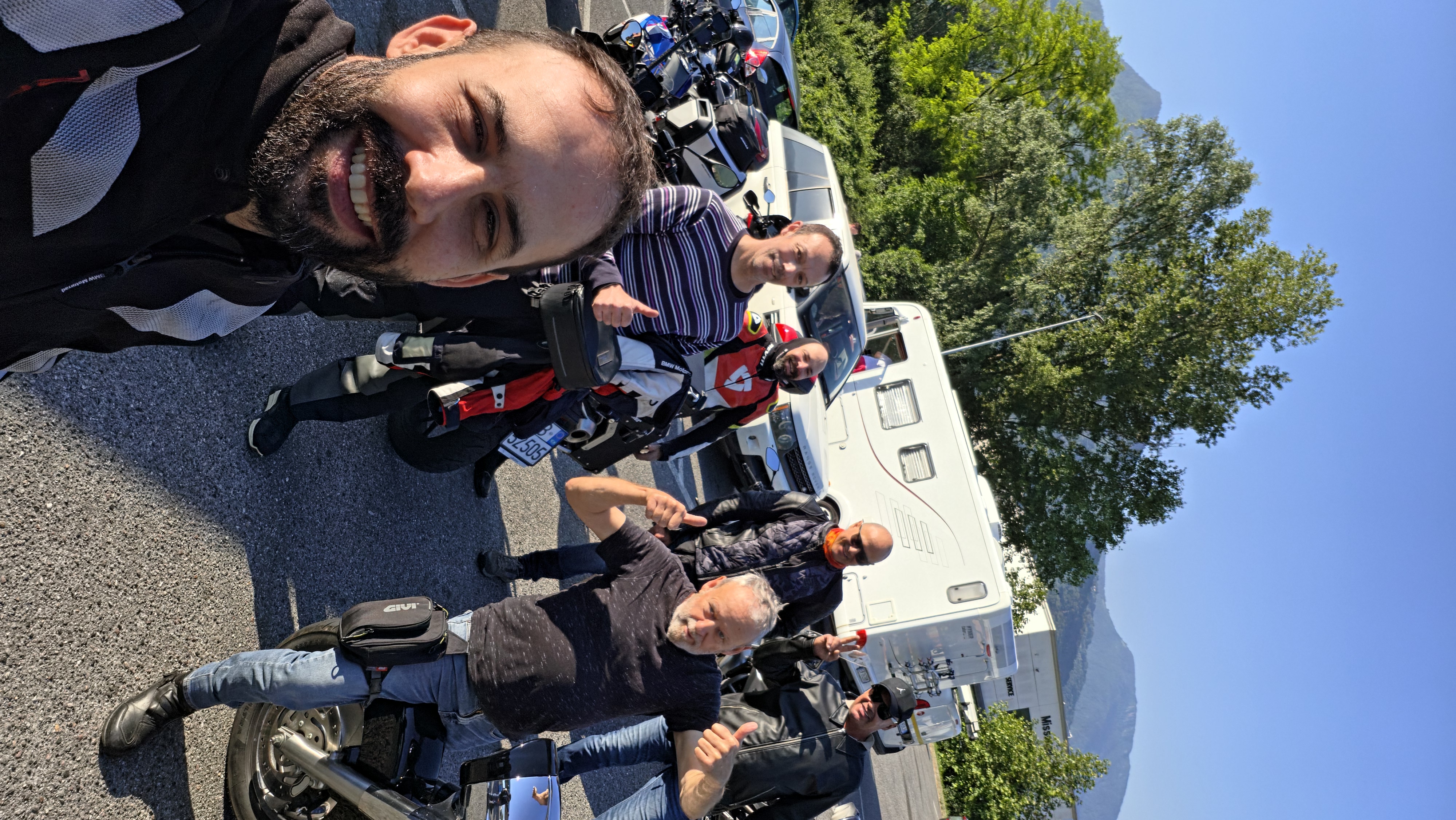
It was one of those mornings when you wake up already wearing your helmet in your mind. Clear skies, full tanks, six friends leaving Milan heading north. No rigid schedule. Just the curves, the mountains and the freedom that only a motorcycle trip through Italy can give.
Halfway there, a seventh friend joined us from Brescia. Seven riders in the Italian Alps — that's an energy of its own. We had coffee, laughed, and set off.
What followed was 550 kilometers of motorcycle touring in the Alps that stay with you forever.
Passo Gavia: Beauty That Punishes Distraction
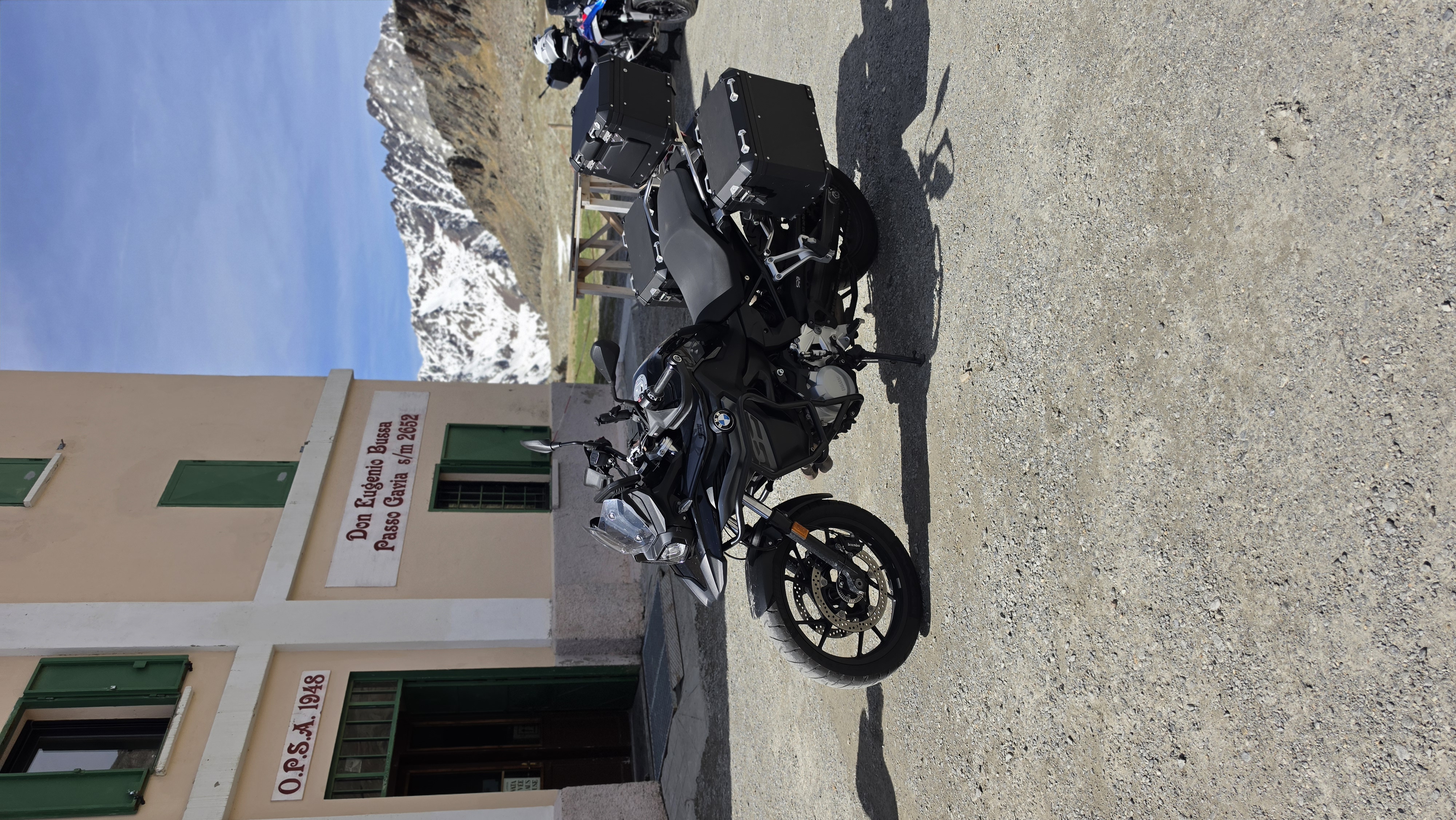
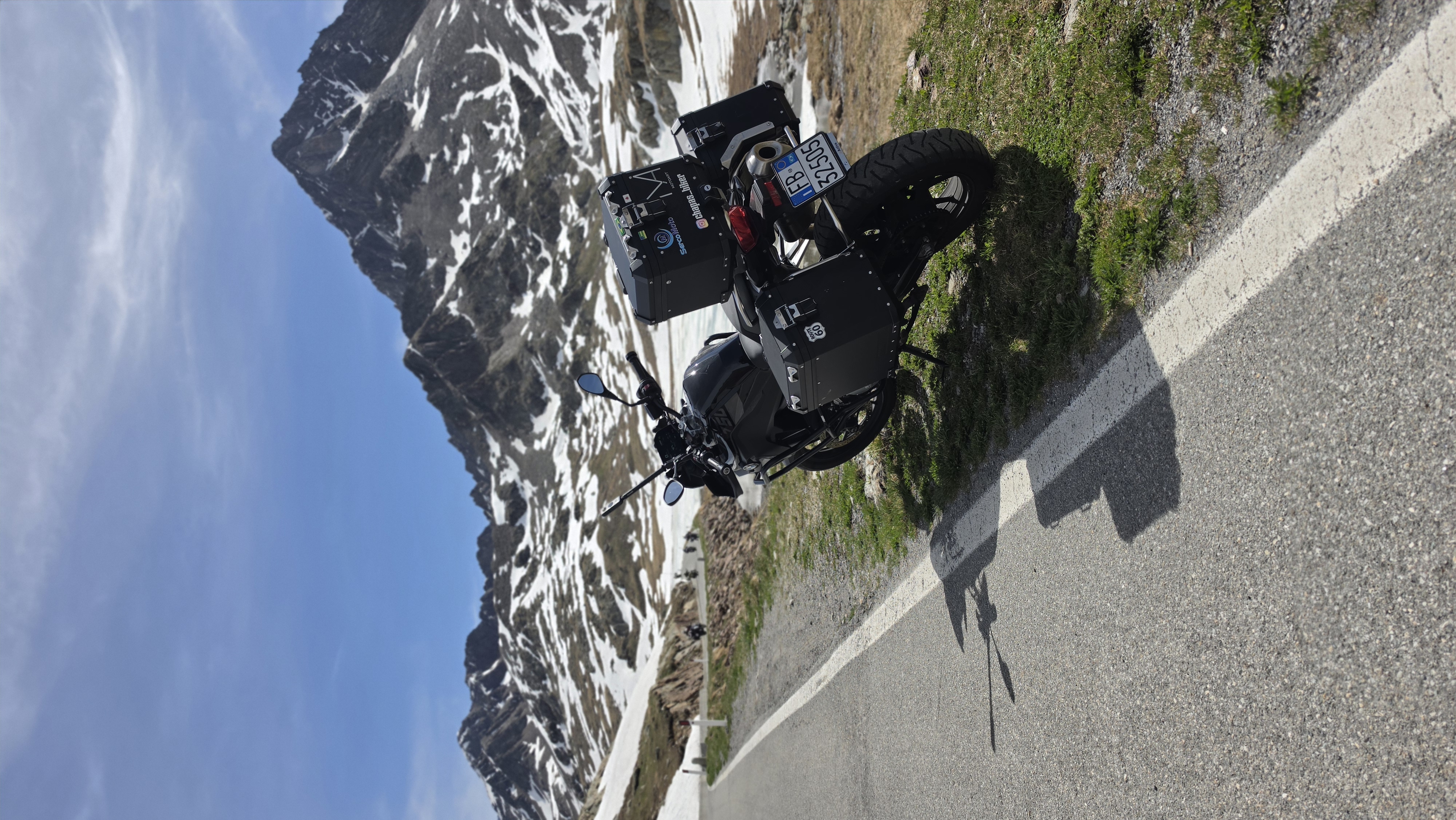
The first serious challenge of the day. Passo Gavia connects Ponte di Legno to Bormio via the SS300 — one of the most spectacular scenic roads in Italy — covering 44 km and 1,394 meters of elevation change, from 1,258 m up to the summit at 2,652 m.
It's a pass with character. The road is paved but narrow, with stretches barely wide enough for two cars. The southern side averages an 8% gradient with peaks of 16%, featuring hairpin turns that demand full attention on larger bikes. Safety barriers? Almost none. The drop, in several places, is straight down.
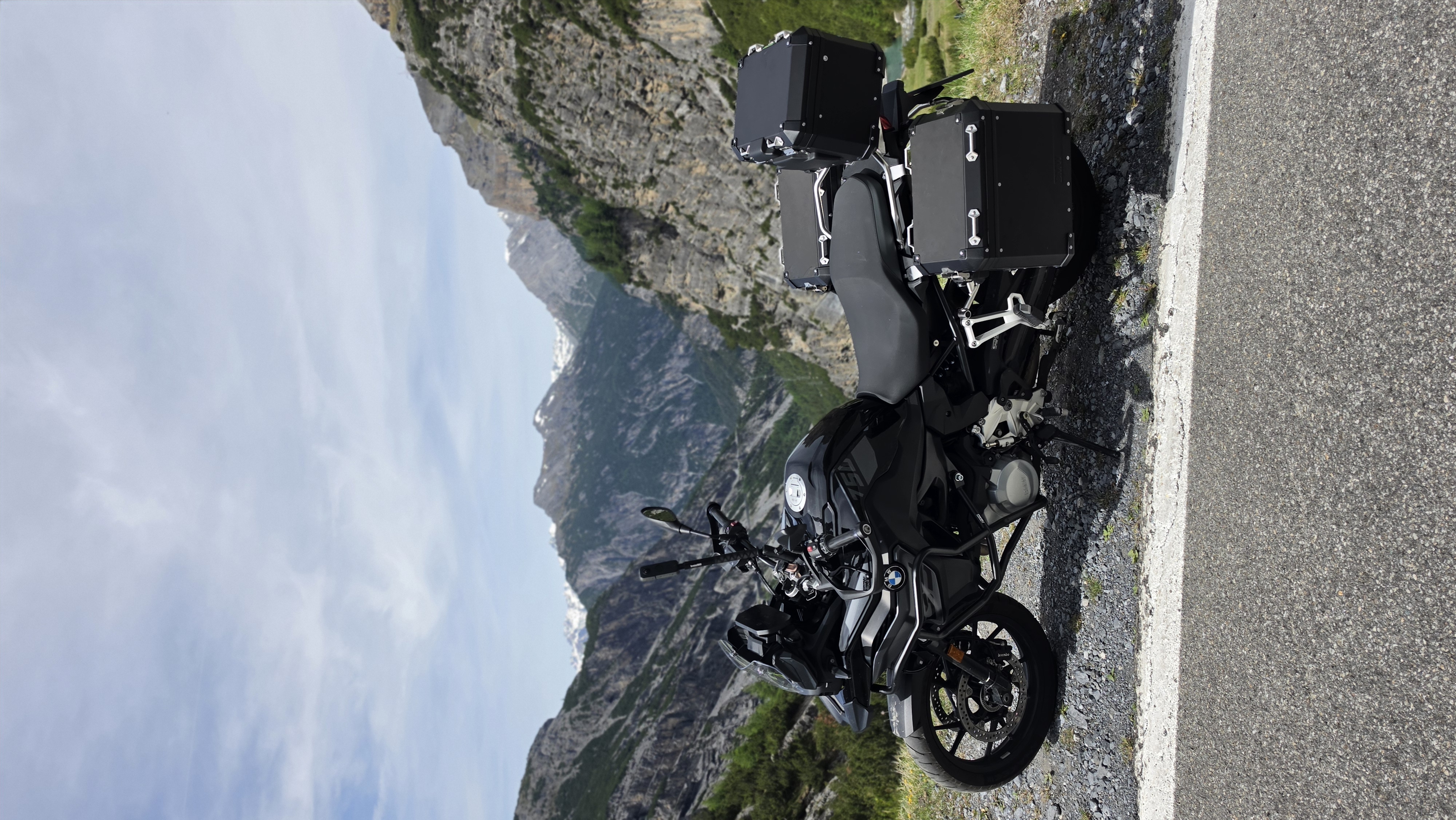
But the scenery makes it all worthwhile. Above the treeline from the very start, the Gavia opens onto high-altitude meadows, snowfields alongside the road even in summer, and two lakes — Lago Bianco and Lago Nero — framed by sheer rock walls. At the summit, the wind cuts cold and silence is total. One of the best roads for motorcyclists in all of Lombardy.
Bormio: Gateway to the Great Passes
We descended to Bormio — a spa town at the heart of the Italian Alps and a perfect hub for motorcyclists. A regular stage of the Giro d'Italia, it's the convergence point for some of the most legendary Alpine passes: Stelvio, Gavia, Mortirolo, Umbrail. About 200 km from Milan via the SS36. We stopped for coffee, took a breath, and headed toward the king of all passes.
Passo dello Stelvio: 88 Curves, 2,757 Meters, a Legend
If there is one road in Italy that every motorcyclist in the world wants to ride at least once, that road is called Passo dello Stelvio.
At 2,757 meters, it is the highest paved mountain pass in Italy — and the second highest in Europe. It has 88 numbered hairpin bends: 48 on the South Tyrol side and 40 on the Lombardy side. The road was built between 1820 and 1825 by engineer Carlo Donegani, who spent a full year just planning the route before construction began. It took 2,500 workers and five years to complete — built to connect Lombardy (then part of the Austrian Empire) with the Tyrol, opening a route from Vienna to Milan.
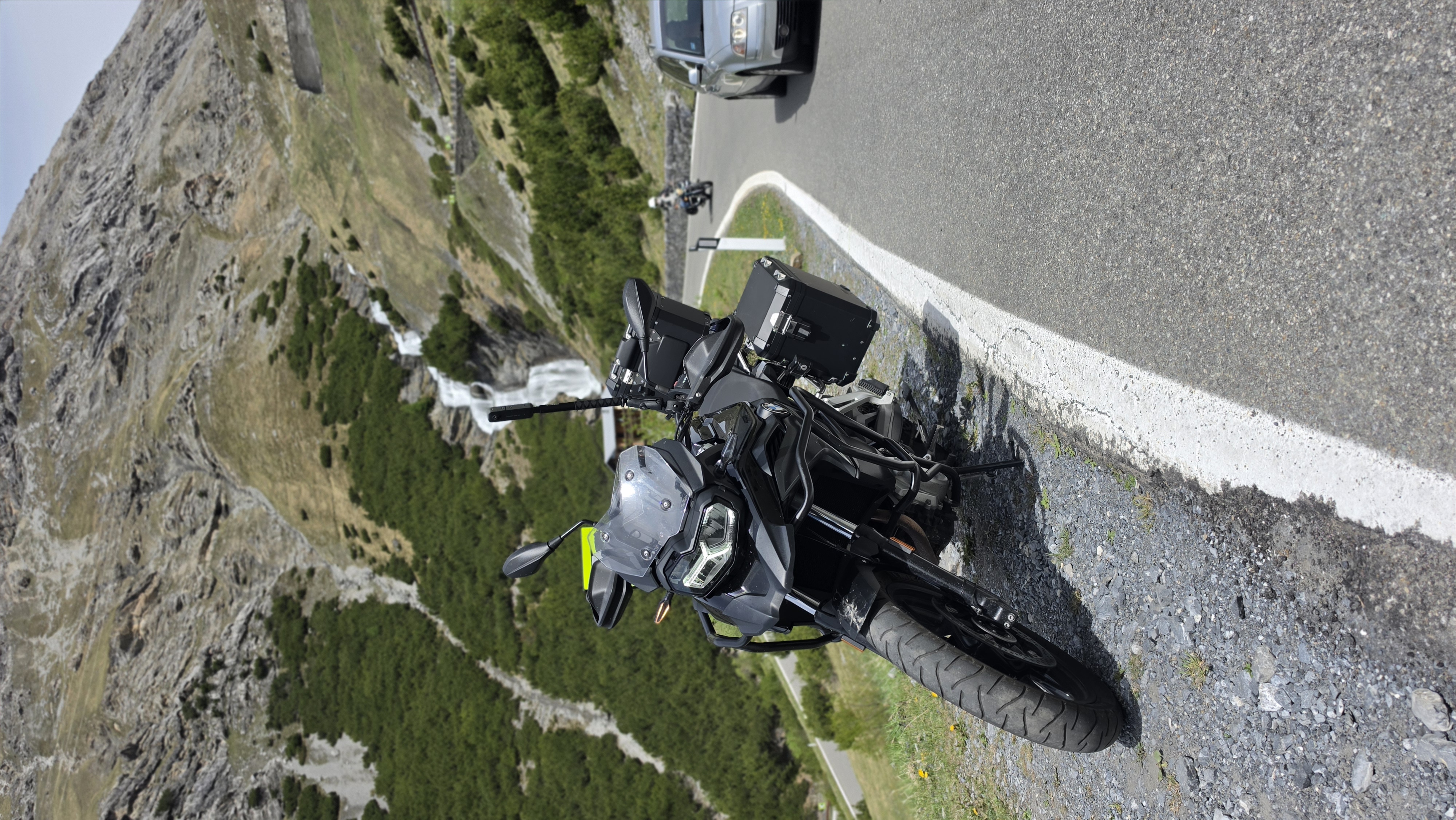
Riding the Stelvio by motorcycle is an experience unlike any other road. The curves count down — 48, 47, 46 — while the altitude climbs and the landscape transforms. At the top, the Swiss border is just a few kilometers to the north. In summer, motorcyclists from all over the world gather here. It was impossible not to exchange a nod with every rider passing by.
At the summit, with 88 switchbacks below you, the icy wind and a panoramic view no photograph can contain — you understand why the Stelvio is one of the most famous roads in Europe for motorcycle riders.
The Rifugio Panino
Right there, at one of the mountain huts on the Stelvio, we made the obligatory stop: the Vinschgerl. This is the rustic, dark bread of the Val Venosta — rye flour, cumin, fennel, coriander — a symbol of the Tyrolean culture of this borderland between Italy, Austria and Switzerland. Split open, filled with speck, mustard and mayonnaise, served on a wooden board overlooking the switchbacks below. You can't replicate that taste anywhere in the city. It only works with that cold, after that climb.
Lake Resia: The Tower That Survived the End of a World
After descending the Stelvio through the Val Venosta, we reached Lake Resia. The landscape changes completely — steep gorges give way to a wide, green valley with Tyrolean villages on the slopes and the Italian Alps in the background.
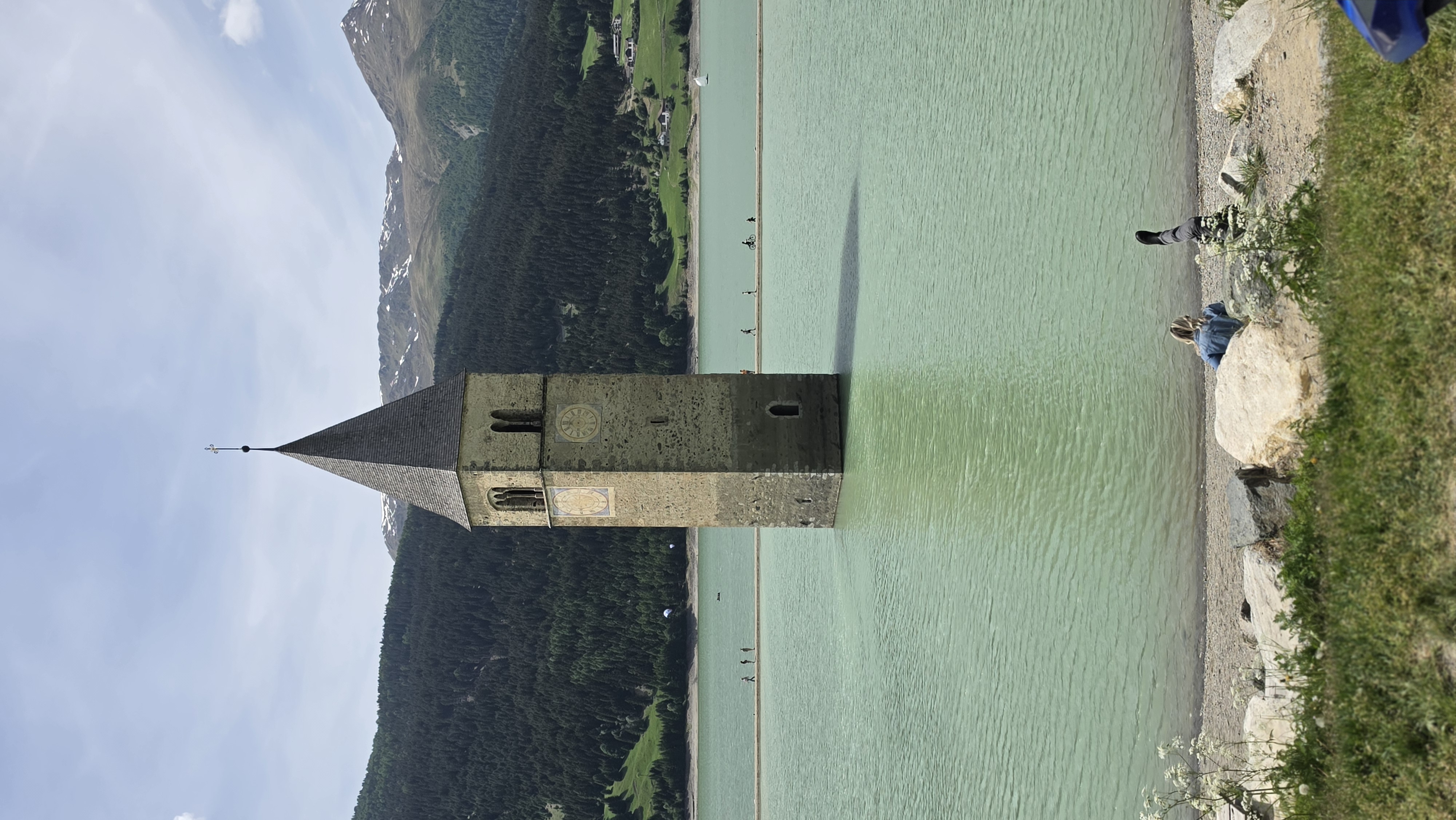
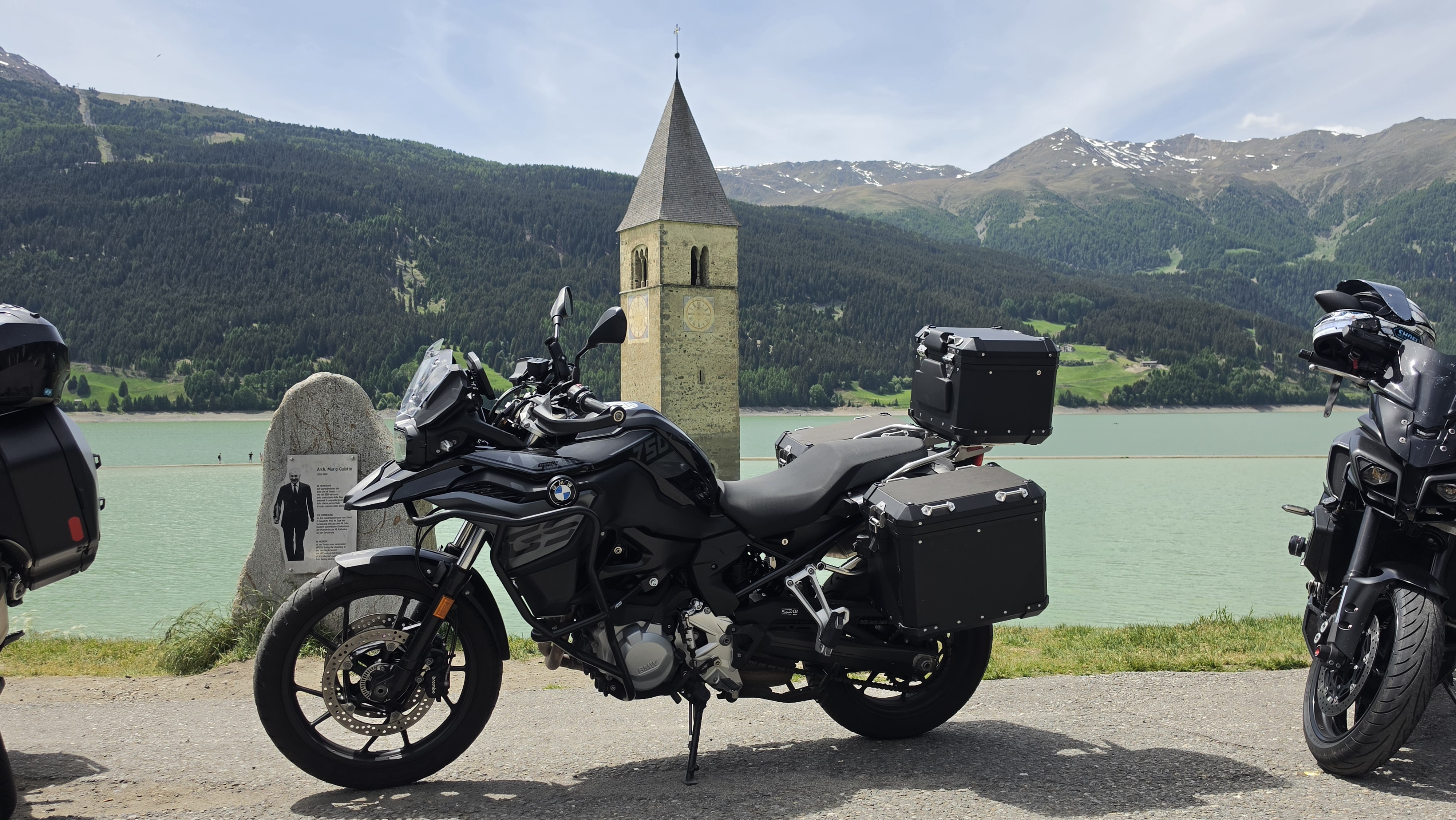
And in the middle of the lake, a solitary tower rising from the water.
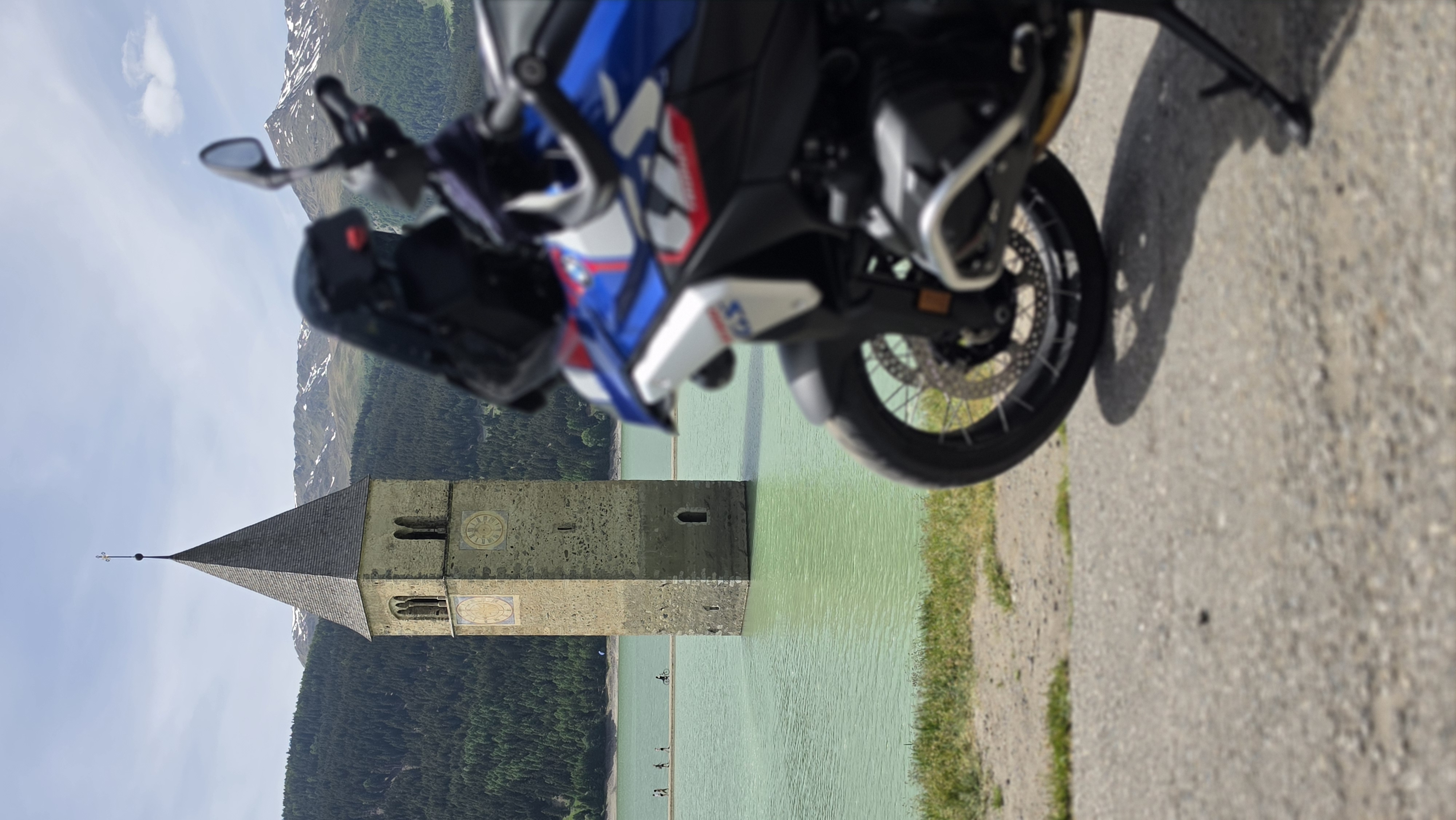
The bell tower of Lake Resia is one of the most haunting symbols in the Alps. It is all that remains of the old village of Curon Venosta — an entire community that was flooded in 1950 to build a hydroelectric reservoir by the Montecatini company. Residents were expropriated with minimal compensation, notified in Italian in a village where nearly everyone was illiterate and spoke German. By the time protests began, it was too late.
On July 23, 1950, 150 explosive charges were detonated in the village buildings. The Church of Santa Caterina held out for four days before being demolished piece by piece. The bell tower, however, would not fall — and was declared a historical monument. It stood there, alone, as the waters rose.
Today, when the lake freezes in winter, it's possible to walk out to the bell tower on the ice. In summer, it emerges from the water like an unanswered question. For a motorcyclist arriving after a day of riding through the Italian Alps, the effect is breathtaking.
Austria: Nauders and the Road to Samnaun
From Lake Resia, we crossed into Austria. The Resia Pass marks the border — one of the rare points in Europe where Italy, Austria and Switzerland meet simultaneously, known as the Triple Border.
On the Austrian side, the road descends to Nauders, in the Tyrol. From there, we took the ten switchbacks of the Norbertshöhe, crossed the Swiss border at Martina, and entered the road to Samnaun — 7 narrow, steep kilometers with tunnels carved into the rock and a road surface that's almost always wet.
Samnaun: the Duty-Free Secret in the Swiss Alps
Samnaun is a rarity. This small Swiss village in the canton of Graubünden is the only customs-free zone in Switzerland — because until a few decades ago, it could only be reached by passing through Austria. As a result, it gained special status: cheaper fuel, drinks, perfumes and watches at duty-free prices. The valley is narrow, the mountains close in on all sides, and it feels like you've discovered a secret hidden in the Alps. For anyone on a motorcycle road trip through Europe, it's a stop well worth the detour.
We filled the tanks. With Swiss prices, every saving counts.
Passo Maloja: Europe's Most Spectacular Serpentine
From Samnaun, we descended through the Engadine valley toward Chiavenna. Along the way: Passo Maloja.
Maloja sits at 1,815 meters and connects the Engadine Valley to the Val Bregaglia, linking St. Moritz to Chiavenna — 50 km of stunning scenery in the canton of Graubünden. The pass's defining feature is its Italian side: a near-vertical rock wall serves as backdrop for a serpentine of hairpin bends that looks hand-drawn. It's been called "the most impressive serpentine in Europe" — and anyone who descends it on a motorcycle, curve by curve, with the valley opening up below, understands why.
Since Roman times the Maloja was a trading route between northern and southern Europe. Today it's a classic destination for motorcycle touring in Europe — but it never loses that feeling of passing through something rare, almost secret.
At the base, you re-enter Italy. The landscape softens, the Val Bregaglia opens up, and Chiavenna appears.
Chiavenna and the Acquafraggia Waterfalls
We arrived in Chiavenna with the sun lower in the sky. An ancient stone city in Lombardy, with the Mera River cutting through the center and the famous crotti — natural caverns where the temperature stays around 8°C year-round thanks to a current of air from underground. Wine and cheese are aged here, along with the smoked bresaola of Valchiavenna — slightly different from the better-known Valtellina bresaola, this one is more rustic, cured in the old way.
The final stop was the Acquafraggia Waterfalls, in Borgonuovo di Piuro, a few kilometers from Chiavenna. The name comes from the Latin aqua fracta — "broken water" — and it's an accurate description: the torrent originates at 3,050 meters and descends in overlapping falls over 150 meters high. Leonardo da Vinci was so impressed that he mentioned them as "belle chadute d'aqua" (beautiful waterfalls) in his Codex Atlanticus, today kept at the Biblioteca Ambrosiana in Milan.
We left the bikes and walked to the base of the falls. Even after everything the day had given us, that spectacle of water and rock still made an impression.
Back to Milan
The SS36, along the shore of Lake Como and then through Lombardy. With the adrenaline of four Alpine passes, three countries and a bell tower rising from a lake still coursing through us, the final 150 km felt like an easy bonus.
550 km. Seven friends. One day of motorcycle riding through Europe that none of us will ever forget.
Should You Do It in One Day? The Honest Answer
Yes, it's possible. And it was incredible.
But the honest answer is: don't do it in one day if you can do it in two or three.
This week, a client of Moretto Moto Rental did exactly this motorcycle route through the Italian Alps — over three days. He came back completely in love with it, especially the Stelvio and Lake Resia. Two extra days change everything: more time at the Stelvio summit, a walk to the bell tower of Curon on the frozen lake in winter, a long lunch at a crotto in Chiavenna.
In one day, you complete the route. In two or three days, you live the route.
Practical Tips
Pass opening: Stelvio and Gavia generally open in June and close with the first snowfall in October/November. Always check conditions before you leave.
Fuel: Fill up in Bormio before the Stelvio. In Samnaun, Switzerland, fuel is cheaper — take advantage. On the return, Chiavenna has good stations.
Swiss vignette: Required for Swiss motorways. Around 40 Swiss francs per year, available at border crossings or online.
Speed limits in Switzerland: Fines are proportional to income. Zero tolerance. Respect all limits.
Clothing: Even in July, bring a jacket with a thermal liner. At the summits of Stelvio and Gavia, temperatures can drop to 5°C.
Departure: Leaving from Milan, close to Malpensa Airport, Ponte di Legno is approximately 170 km away. Leave early to enjoy the passes before traffic builds up.
Plan Your Motorcycle Trip Through the Alps with Moretto Moto Rental
Riders arriving at Milan's airports — including Malpensa — will find in Moretto Moto Rental the ideal starting point, less than 30 minutes from the airport, in the Lombardy region.
BMW rental in Italy with departure near Milan — that's exactly what Moretto offers for those who want to ride through Italy and Europe without compromising on quality and safety.
This route can be yours. The same roads, the same stories, the same bell tower rising from Lake Resia.
You just need to show up.
FAQ
Is Passo dello Stelvio always open?
No. It closes in winter, generally from November to May. The Provincia di Bolzano website provides real-time pass conditions.
Can I do this route with a motorcycle rental in Milan?
Yes. Moretto Moto Rental is located near Malpensa Airport and offers BMW GS motorcycles prepared for exactly this kind of route through the Italian Alps.
Do I need a vignette to ride in Switzerland?
Yes, for motorways. Around 45 CHF/year, purchased at the border or online.
Can this route be done on a smaller motorcycle?
Yes, but Gavia has very steep sections. A minimum of 600cc with a good power-to-weight ratio is recommended.
What is the best time for motorcycle touring in the Italian Alps?
June to September. In July and August traffic on the passes is heavy — leave early to enjoy the roads before the crowds arrive.
Motorcycle touring in Italy and Europe — that's what Moretto Moto Rental helps you experience. Check availability and plan the ride of your life.